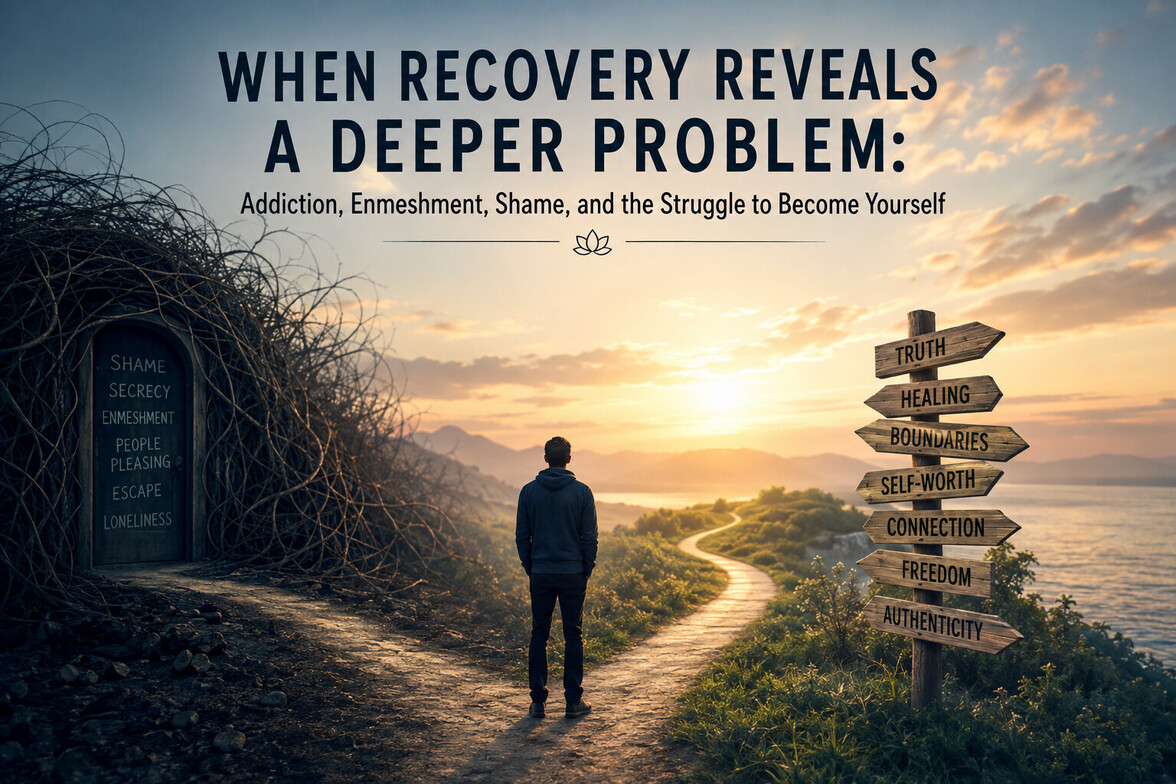
When someone enters therapy for pornography or sexual addiction, the obvious goal is recovery from the addictive behaviour. Stop the pornography. Stop the secrecy. Stop the fantasy life. Become honest. Repair the damage to the relationship.
All of that matters.
But sometimes something unexpected happens.
The person stops acting out, begins doing serious recovery work, and discovers that the addiction was only part of the problem. Underneath it is an older struggle involving shame, identity, emotional regulation, family relationships, and the fundamental question:
Who am I when I am no longer escaping from myself or organizing my life around keeping other people happy?
This is where addiction recovery can become a much deeper journey of psychological development.
The Addiction Was Doing Something
One of the most useful questions we can ask about any addiction is not simply, Why won't this person stop?
A better question is:
What was the addiction doing for them?
Compulsive pornography use can obviously provide sexual excitement and gratification. But over time, it can serve many other psychological functions.
It can soothe anxiety.
It can numb anger.
It can relieve loneliness.
It can provide escape from frustration.
It can create an illusion of power.
It can temporarily relieve feelings of inadequacy.
And perhaps most importantly, it can create a secret psychological space where nobody else has any demands.
For someone who has spent much of life adapting to other people, that private fantasy world can become one of the few places where they experience something resembling autonomy.
The tragedy is that what initially feels like freedom eventually becomes another prison.
When the Child Becomes Responsible for the Mother
One developmental pattern I frequently encounter in this work is maternal enmeshment.
Enmeshment occurs when the psychological boundaries between parent and child are insufficiently developed. Instead of gradually supporting the child's emergence as a separate person, the relationship subtly communicates that separation threatens the bond.
The child may become unusually sensitive to the mother's moods.
He learns to anticipate what she wants.
He avoids disappointing her.
He feels responsible for her emotional wellbeing.
He may become her confidant, protector, companion, or "special" child.
From the outside, this can look like an exceptionally close mother-son relationship.
Inside the child, however, another message may be forming:
Your separateness hurts people.
This creates an enormous developmental dilemma.
How do I become myself without betraying the person I love?
Guilt Becomes the Glue
One of the most powerful mechanisms maintaining enmeshment is guilt.
The adult child may feel guilty for:
-
saying no
-
wanting privacy
-
choosing a spouse over a parent
-
declining invitations
-
setting limits
-
accepting less contact
-
disagreeing
-
simply wanting a life of his own
Intellectually, he may know perfectly well that he has the right to make these choices.
Emotionally, however, they can feel like acts of abandonment.
This distinction is enormously important in therapy.
Recovery does not necessarily mean:
"I no longer feel guilty."
Often it means:
"I can feel guilty without allowing guilt to make my decisions."
That is differentiation.
The Golden Child Has a Price to Pay
Enmeshment can be particularly difficult to recognize when the child was idealized rather than neglected.
The successful child may become the golden child.
He performs well.
He succeeds academically.
He excels at sports.
He behaves.
He makes his mother proud.
He becomes the person who appears to have everything together.
But there can be a hidden price.
His worth becomes associated with performance.
He learns:
I am valuable when I succeed.
I am safe when people approve of me.
I am lovable when I don't disappoint anyone.
Eventually he may become a highly competent adult who nevertheless has very little internally generated self-worth.
He needs the world to continually tell him he is okay.
The Missing Father
For boys in particular, the father's psychological role can become important in this process.
A healthy father does not literally "take the boy away" from his mother. But symbolically, fathers and other healthy male figures can help a boy discover a world beyond the maternal relationship.
They can help communicate:
You can separate.
You can take risks.
You can disagree.
You can become your own man.
You can survive your mother's disappointment.
When the father is emotionally absent, frightening, humiliating, or unavailable, this developmental bridge may be weakened.
The boy can remain psychologically caught between longing for maternal approval and fearing paternal authority.
Later, he may appear independent while remaining profoundly dependent on external validation.
Pornography as a Secret Form of Independence
From this perspective, pornography can take on another meaning.
It can become a primitive form of individuation.
In fantasy, there is no disappointed mother.
No angry partner.
No expectations.
No emotional caretaking.
No need to explain.
No possibility of rejection.
Fantasy belongs entirely to the self.
It can therefore provide temporary experiences of power, autonomy, sexuality, desirability, and control that have not been sufficiently developed in ordinary life.
But because the autonomy exists only in secrecy, genuine individuation never occurs.
The person becomes divided.
There is the compliant public self and the secret private self.
Eventually the psychological cost of maintaining these two worlds becomes enormous.
What Happens When the Addiction Stops?
This is one of the most interesting stages of recovery.
Once the addictive behaviour stops, the feelings it was regulating don't disappear.
They become more visible.
Suddenly the person notices:
I don't know how to handle anger.
I panic when someone is disappointed in me.
I don't know what I want.
I have trouble saying no.
I don't trust my own perceptions.
I need everyone around me to be okay before I can be okay.
I am terrified of conflict.
This can initially make recovery feel worse rather than better.
But something important is happening.
The person is becoming conscious.
The addiction was functioning like an emotional anaesthetic. Without it, the developmental work that was postponed for years finally becomes possible.
Betrayal Trauma Complicates Everything
When sexual addiction has occurred within a committed relationship, there is another reality that cannot be ignored: the partner has been betrayed.
Discovery can profoundly destabilize a person's sense of reality.
What was true?
What wasn't true?
Was I desirable?
Was our sexual relationship real?
What else don't I know?
Hypervigilance, anger, questioning, fear, monitoring, and emotional volatility can follow.
The recovering partner must develop the capacity to tolerate some of this.
Accountability matters.
Transparency matters.
Empathy matters.
Consistency matters.
The betrayed partner cannot simply be told to "get over it."
But there is another side of the equation that also needs to be discussed.
Betrayal Does Not Eliminate Boundaries
There is a dangerous point at which accountability can become self-erasure.
A recovering person can begin believing:
Because I hurt you, I no longer have the right to disagree with you.
Or:
Because I lied in the past, my perceptions no longer matter.
Or:
Because you are traumatized, I must absorb whatever you say or do.
That is not recovery.
It is another form of enmeshment.
The recovering person must learn to hold two truths simultaneously:
I caused profound harm and am responsible for repairing what I can.
And:
I remain a human being entitled to dignity, boundaries, and psychological safety.
Both matter.
When Marriage Recreates Childhood
This is where the work can become particularly fascinating and painful.
A person raised to monitor a parent's emotional state may unconsciously recreate that system in adult relationships.
The names change.
The nervous system does not.
The pattern becomes:
My partner is upset.
Therefore I must have done something wrong.
I need to fix it.
I need to explain.
My explanation isn't accepted.
I panic.
I explain more.
I begin doubting myself.
Eventually I collapse, become defensive, withdraw, or explode.
The other partner experiences this reaction as further evidence of dishonesty or emotional abandonment.
Their anxiety increases.
They pursue harder.
The recovering partner becomes increasingly frightened.
And the cycle begins again.
Two frightened people become locked together, each activating the other's deepest wounds.
The Freeze Response
People sometimes mistake freezing for dishonesty.
But under intense attachment threat, the nervous system can override reflective thought.
The person may experience:
-
flushing
-
racing thoughts
-
cognitive blankness
-
inability to find words
-
dissociation
-
panic
-
an overwhelming urge to escape
The therapeutic task is not to excuse behaviour because of the nervous system.
It is to help the person recognize what is happening early enough to respond differently.
Eventually someone can learn to say:
"I'm freezing right now. I want to answer you honestly, but I need a few minutes to regulate myself."
That is very different from disappearing, lying, minimizing, or becoming defensive.
From Shame to Accountability
Perhaps the most important distinction in this entire process is between shame and accountability.
Accountability says:
I did something harmful.
Shame says:
I am something harmful.
Accountability allows repair.
Shame frequently produces collapse.
For someone whose deepest belief is already I am not good enough, relationship conflict can quickly become psychological annihilation.
"I handled that badly" becomes:
"I can't do anything right."
"I hurt someone" becomes:
"I destroy everyone."
"I made a mistake" becomes:
"Everyone would be better off without me."
When shame reaches this level, suicidal thinking can emerge.
This is why self-compassion is not letting someone "off the hook."
It is actually necessary for genuine accountability.
A person needs enough psychological stability to look directly at what they have done without either denying it or destroying themselves because of it.
Learning Healthy Aggression
There is another capacity that often needs to be developed: healthy aggression.
Not violence.
Not rage.
Not domination.
Healthy aggression is the life force that allows us to say:
This is what I think.
This is what I feel.
I disagree.
I want this.
I don't want that.
No.
Enough.
This matters to me.
People raised in enmeshed systems often have difficulty accessing this energy because disagreement once threatened attachment.
Anger gets suppressed until it emerges indirectly through resentment, withdrawal, compulsive behaviour, fantasy, or occasional explosions.
Recovery therefore requires reclaiming the capacity to oppose someone without abandoning them or oneself.
Individuation Is the Deeper Recovery
Carl Jung used the term individuation to describe the lifelong process of becoming the person one actually is rather than remaining unconsciously governed by parental complexes, social expectations, and inherited psychological patterns.
From this perspective, addiction recovery can become part of individuation.
The person begins asking:
What do I actually believe?
What do I want?
What do I value?
Where do I end and another person begin?
Can someone be disappointed in me without my collapsing?
Can I love someone without becoming responsible for their emotional state?
Can I tolerate being misunderstood?
Can I tell the truth even when the truth doesn't produce the response I want?
These are much harder questions than simply:
"Did I act out today?"
But eventually they become the real recovery work.
Learning to Stand on Truth
For someone who has lived secretly for years, truth initially feels strangely unstable.
He may tell the truth and then immediately begin questioning himself when another person doesn't believe him.
Real recovery gradually changes this.
He begins developing an internal centre of gravity.
He can say:
"I know what happened."
"I understand why you don't trust me yet."
"I am willing to listen to your pain."
"I am not willing to invent a different answer because mine doesn't satisfy you."
That is not defensiveness.
When done calmly and honestly, it is differentiation.
The Goal Is Not Independence
Healthy differentiation does not mean emotional cutoff.
It does not mean:
I don't need anybody.
I don't care what you think.
I'm going to do whatever I want.
That is often pseudo-independence.
The deeper goal is connection without fusion.
I can love my mother without managing her life.
I can love my partner without controlling her emotions.
I can hear someone's anger without automatically surrendering my reality.
I can make amends without living permanently on trial.
I can accept responsibility without abandoning myself.
Becoming Your Own Person
Eventually, the deepest question in this kind of recovery becomes surprisingly simple:
Who am I when I am no longer organizing my life around keeping someone else emotionally stable?
For someone who has spent decades performing, pleasing, hiding, escaping, and seeking validation, that question can feel terrifying.
It can also be liberating.
Recovery begins with stopping the behaviour.
But it cannot end there.
The deeper journey is toward becoming a person capable of truth without terror, intimacy without fusion, sexuality without secrecy, responsibility without shame, boundaries without hatred, and love without self-erasure.
Perhaps that is what recovery ultimately asks of us:
Not merely to stop doing what was destroying our lives.
But to finally become the person we never had enough freedom to become.

James Leitch
Contact Me