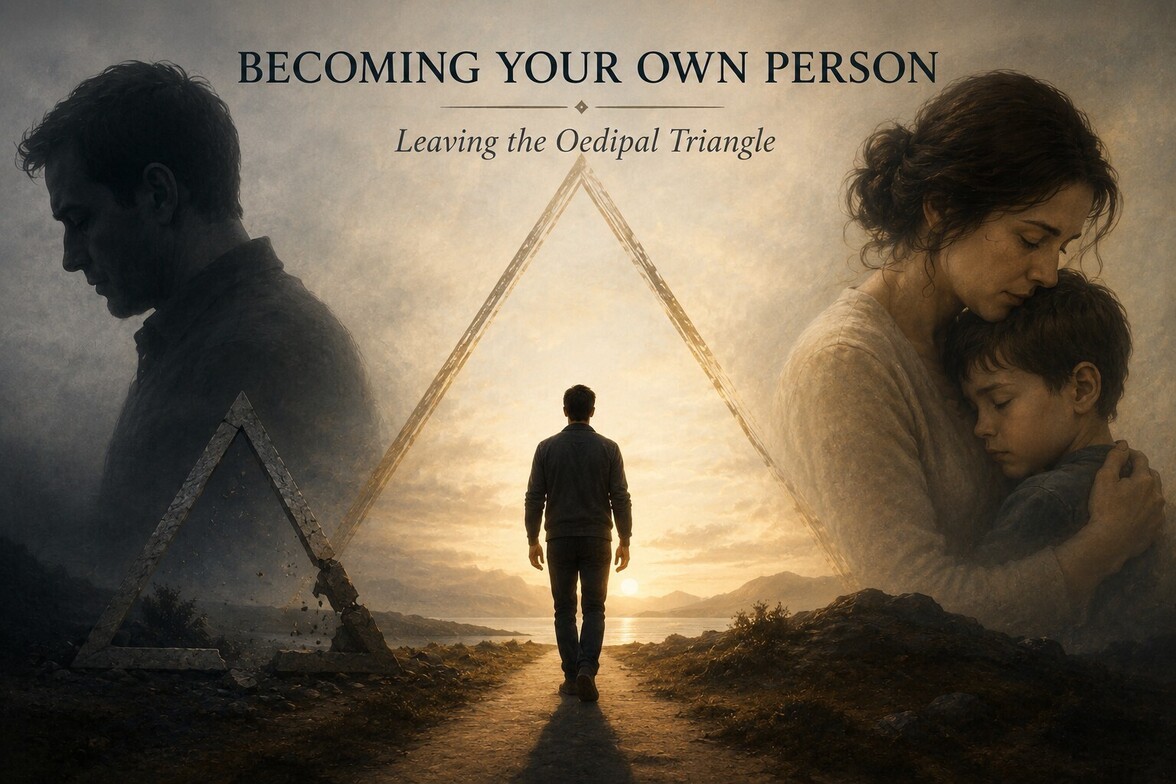
One of Freud’s most enduring—and controversial—contributions to psychology was the Oedipus complex, named after the ancient Greek story of Oedipus, who unknowingly kills his father and marries his mother.
Taken literally, the story can seem remote from ordinary life. Very few men kill their fathers and marry their mothers.
But myths are rarely interesting because they are literally true. They endure because they express something psychologically true.
When we read the story symbolically rather than literally, the Oedipal drama can become surprisingly recognizable.
The Symbolically Absent Father
Many men I work with grew up with a father who was absent.
Sometimes he was physically absent through separation, divorce, abandonment, illness, death, addiction, or the demands of work. But a father can also be physically present while remaining emotionally unavailable.
In either case, from the child’s psychological perspective, the father may be experienced as symbolically dead: he is not sufficiently present as a third person within the emotional relationship between mother and son.
This absence can leave an opening in the family system.
And sometimes the son unconsciously steps into it.
The Son as Surrogate Partner
A mother who is lonely, unhappy in her marriage, overwhelmed, or emotionally unsupported may begin turning toward her son for forms of emotional support that would more appropriately belong within an adult relationship.
The son becomes her confidant.
He hears about her disappointments, worries, loneliness, or problems with his father. He may feel responsible for protecting her, reassuring her, making her happy, or simply being the person who understands her.
He has not literally married his mother.
But psychologically, he may begin occupying something resembling the position of a partner.
In contemporary language, we might understand aspects of this dynamic through concepts such as enmeshment, parentification, triangulation, or emotional incest. These terms describe somewhat different phenomena, but they share an important theme: the boundaries between parent and child have become blurred.
The child is being asked, implicitly or explicitly, to carry emotional responsibilities that exceed his developmental role.
The Seduction of Being Special
There is another side to this dynamic that is easy to overlook.
Being placed in this position can feel good.
The boy may become the special son, the protector, the man of the house, the one his mother trusts most, or the person who understands her in a way that nobody else does.
He may become the golden child.
This can create a powerful sense of importance and belonging. The boy may feel loved precisely because he is needed.
But there is a cost.
The developmental task of childhood and adolescence is gradually to separate psychologically from our parents—to discover our own preferences, values, desires, relationships, and identity.
In other words, we must become differentiated.
If a boy experiences his independence as abandoning or betraying his mother, differentiation becomes much more difficult.
He may unconsciously learn:
If I become fully myself, someone I love will suffer.
The Problem of Differentiation
Healthy differentiation does not mean rejecting our parents. It means becoming capable of remaining emotionally connected to them without being psychologically governed by them.
I can love you without becoming responsible for your emotional life.
I can disappoint you without believing I have destroyed you.
I can disagree with you without losing myself.
I can leave without abandoning you.
And perhaps most importantly:
I can discover what I want, rather than organizing my life around what you need from me.
For someone raised within an enmeshed family system, these seemingly ordinary acts of adulthood can carry enormous emotional weight.
Independence may produce guilt.
Boundaries may feel cruel.
Conflict may feel dangerous.
Other people’s disappointment may feel unbearable.
The adult man may therefore appear independent while remaining psychologically entangled with the emotional world of his childhood.
Addiction as a Secret Room
This is where addiction can sometimes enter the picture.
Addiction has many causes, and it would be misleading to reduce it to any single childhood dynamic. But for some men, addictive behaviour can serve an important psychological function.
It creates a private world.
Alcohol, drugs, pornography, compulsive sexual behaviour, gambling, gaming, food, work, or other compulsive behaviours may become a place that belongs entirely to him.
Nobody else can enter.
For a man who grew up without sufficient psychological boundaries, the addictive world can function almost like a secret room inside the self.
There, temporarily, he belongs only to himself.
The tragedy is that what begins as an attempt to create freedom eventually becomes another form of imprisonment.
The substance or behaviour that initially offered escape, autonomy, soothing, excitement, or privacy gradually begins controlling the person who turned to it for relief.
From Mother to Partner
The unresolved Oedipal dynamic can also reappear in adult intimate relationships.
A man who has never fully differentiated from his mother may desperately desire closeness while simultaneously experiencing closeness as a threat to his autonomy.
He may want intimacy and then withdraw from it.
He may choose partners who need rescuing or caretaking because this feels familiar.
He may become extraordinarily sensitive to a partner’s disappointment.
He may avoid conflict, conceal parts of himself, retreat into work or fantasy, or maintain a secret life.
He may repeatedly find himself caught between two powerful needs:
Please love me.
and
Please don’t possess me.
From an attachment perspective, this can resemble the complicated dance of wanting connection while fearing what connection will demand.
The problem is not simply that the man has not separated from his mother.
It is that he may never have learned that love and separateness can coexist.
Leaving the Oedipal Triangle
In the myth, Oedipus does not know who he really is.
That may be the deepest psychological dimension of the story.
The modern Oedipal question is therefore not simply:
How do I separate from my mother?
It is:
Who am I when I am no longer the person my family needed me to be?
That can be a frightening question.
If I am no longer the good son, the special son, the protector, the confidant, the rescuer, the successful one, or the person who keeps everyone emotionally stable—who am I?
Psychotherapy can provide a place to begin answering that question.
The work involves grieving what was missing, recognizing the family roles we inherited, developing boundaries, tolerating guilt and disappointment, understanding the purpose our addictions or compulsions may have served, and gradually discovering a self that exists independently of those roles.
This does not require condemning our parents.
Most parents are acting from their own wounds, histories, loneliness, and limitations. Understanding what happened is different from assigning blame.
The goal is differentiation.
Becoming Your Own Person
Perhaps the psychological resolution of the Oedipal complex is ultimately about leaving home—not necessarily geographically, but internally.
The father no longer needs to be defeated.
The mother no longer needs to be rescued.
And the son no longer needs to remain a son psychologically for the rest of his life.
He can become a man capable of standing on his own while remaining connected to others.
Only then does adult intimacy become something fundamentally different from childhood enmeshment.
A partner does not have to become another person whose emotional wellbeing he must manage. Nor does intimacy have to mean surrendering himself.
He can remain himself while loving another person.
He can have boundaries without disappearing.
He can need someone without becoming engulfed by them.
He can belong to himself and still belong with another.
And perhaps that is the developmental task hidden inside the ancient myth: not killing the father or marrying the mother, but leaving the psychological triangle behind and becoming the author of your own life.

James Leitch
Contact Me