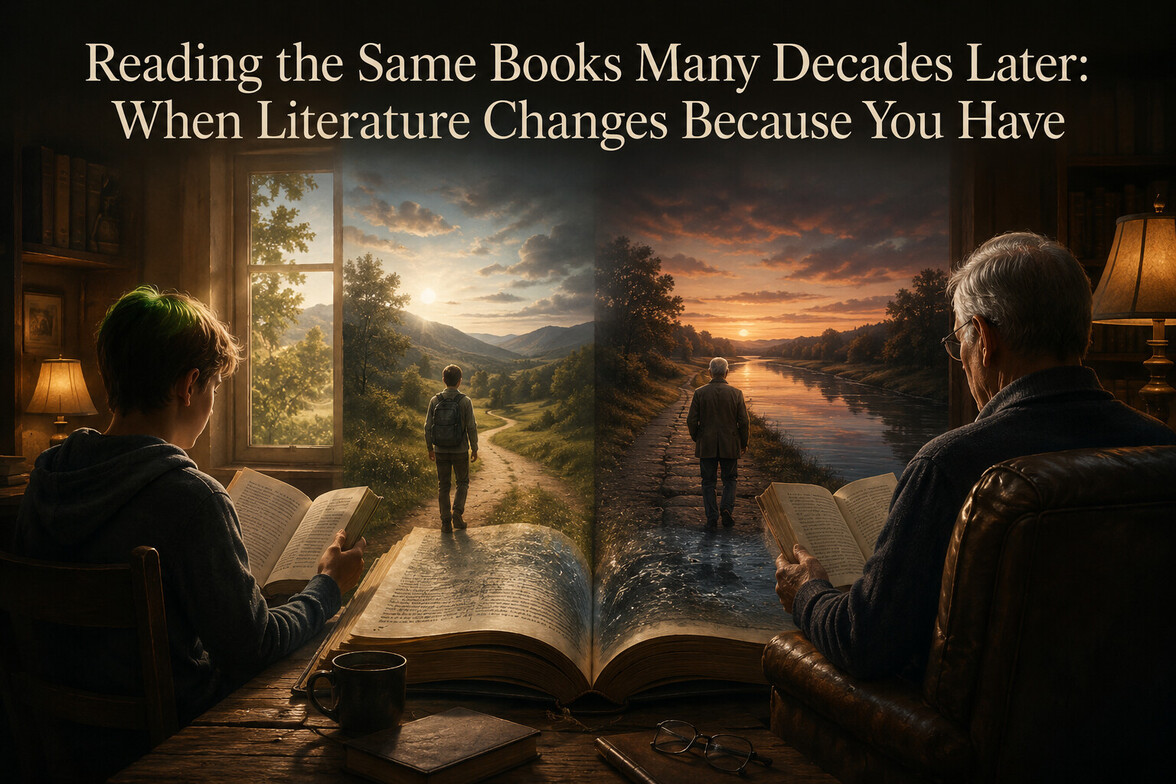
Over the past while, I have been returning to a number of novels that I first encountered many decades ago. Lord of the Flies, The Old Man and the Sea, The Sun Also Rises, The Catcher in the Rye, Of Mice and Men, Animal Farm, The Pearl, and most recently Hermann Hesse's Siddhartha.
What has surprised me is how different these books seem now.
Of course, the books haven't changed.
I have.
We Never Really Read the Same Book Twice
When we read a novel when we are young, we inevitably encounter it through the limited experience we have accumulated at that point in our lives. We may understand the plot, recognize the themes and even write an intelligent essay about what the author is trying to say.
But there are some things we simply cannot understand yet because we haven't lived them.
Love and loss. Success and failure. Ambition and disappointment. Marriage and divorce. Friendship and loneliness. Finding ourselves and losing ourselves. Making choices we regret. Discovering that some of our greatest mistakes eventually became our greatest teachers.
Many decades later, we bring all of this with us when we return to the same book.
The words haven't changed, but the reader has.
And because the reader has changed, the book changes too.
Literature and the Inner Life
This is one of the things I have increasingly appreciated about great literature.
The best stories operate simultaneously on two levels.
There is an outer story involving characters, relationships, conflicts and events. But beneath it there is often another story taking place—the psychological journey of the character.
This is also how I have come to understand psychotherapy.
The presenting problem is rarely the entire problem. Difficulties at work may reveal deeper questions about identity and self-worth. Relationship problems can expose attachment patterns established much earlier in life. Addiction can become an attempt to regulate feelings that seem unbearable. Career dissatisfaction may eventually become a much larger question about meaning and vocation.
The external circumstances matter enormously.
But they may also be telling us something about what is happening internally.
Good fiction does the same thing.
Returning to Siddhartha
Of all the novels I have recently reread, Siddhartha affected me most deeply.
Perhaps this is because the inner journey isn't simply hidden beneath the story.
It is the story.
Siddhartha begins as a young man searching for enlightenment. He studies religious teachings. He becomes an ascetic. He encounters the Buddha. He then leaves the spiritual life and enters the world of money, sexuality, desire and material success.
Eventually, that life becomes empty as well.
He experiences despair.
And finally he finds himself beside a river.
What is remarkable is that none of these stages ultimately proves meaningless.
Siddhartha initially believes there must be a correct path that will lead him toward wisdom. But gradually he discovers something much more complicated.
Wisdom cannot simply be taught.
It has to be lived.
The Parts of Life We Would Rather Erase
This becomes particularly powerful when viewed from later in life.
Most of us can look backwards and identify periods we wish had gone differently.
We may wish we had made different choices, avoided certain relationships, pursued another career, recognized a problem earlier, or understood ourselves better.
We can easily divide our lives into the parts that "worked" and the parts that didn't.
But psychological development rarely happens that neatly.
Sometimes the experiences we most regret eventually become the experiences from which we learn the most.
This does not mean that suffering is inherently good or that destructive behaviour should be romanticized. Some experiences cause very real harm.
But even painful experiences can eventually be metabolized psychologically.
What once seemed meaningless can become meaningful.
What once seemed like failure can become instruction.
What once seemed like a detour can turn out to have been part of the journey.
The River
The central symbol of Siddhartha is the river.
Siddhartha gradually learns to listen to it.
The river contains countless voices—joy and sorrow, birth and death, desire and renunciation, beginnings and endings.
Eventually these voices cease to sound separate.
They become part of something larger.
Psychologically, this is a profound image.
Much of our early life is spent dividing experience into opposites.
Success or failure.
Good or bad.
Spiritual or worldly.
Strong or weak.
Right choice or wrong choice.
But maturity often requires something different.
We begin to discover that apparently contradictory parts of ourselves may belong to the same larger life.
Carl Jung called this process individuation—the gradual movement toward becoming a more complete person rather than identifying exclusively with the parts of ourselves we prefer.
The goal is not perfection.
It is wholeness.
Psychotherapy and the River
There is another character in Siddhartha whom I appreciate much more upon returning to the novel: Vasudeva, the ferryman.
He does remarkably little.
He doesn't lecture Siddhartha.
He doesn't tell him what his life means.
He doesn't provide a sophisticated philosophy.
He listens.
And he continually directs Siddhartha's attention back toward the river.
There is something here that beautifully captures what psychotherapy can be at its best.
A therapist cannot live another person's life for them. Nor can a therapist simply hand someone wisdom.
We can listen.
We can notice patterns.
We can help someone tolerate difficult feelings.
We can sometimes see connections that are difficult to recognize from inside one's own experience.
But ultimately each person has to encounter their own river.
The therapist can accompany someone to its edge.
The client has to learn how to listen.
The Books We Return To
Perhaps this is why returning to literature many decades later can be such a powerful experience.
When we first read a great novel, we ask the book questions.
Many years later, the book seems to ask questions of us.
What happened to the person who first read these pages?
What did you discover?
Where did you lose your way?
What did suffering teach you?
Which parts of yourself did you abandon?
What are you still becoming?
The strange thing about great literature is that it seems capable of waiting for us.
A book can sit quietly on a shelf for decades while we go out and accumulate the experiences necessary to understand something that was there all along.
Then one day we open it again.
The sentences are exactly where we left them.
But we are not.
And perhaps that is one of the great gifts of returning to literature later in life.
We discover that we are not simply rereading the book.
We are rereading ourselves.

James Leitch
Contact Me