In my work with men struggling with addiction, I have often found that the addictive behaviour itself is only part of the story.
For some men, addiction developed within a much larger emotional landscape—one characterized by an enmeshed relationship with their mother, an absent or emotionally unavailable father, difficulty developing a separate sense of self, and a lack of meaningful connection with other men.
In this context, addiction can become more than the pursuit of pleasure.
It can become a way of coping.
And sometimes, paradoxically, it becomes an attempt to create a private psychological space in a life where there was never enough room simply to be oneself.
Recovery therefore involves more than stopping the addictive behaviour.
It involves discovering what the addiction was doing for you—and gradually developing healthier ways of meeting those needs.
First, Put Out the Fire
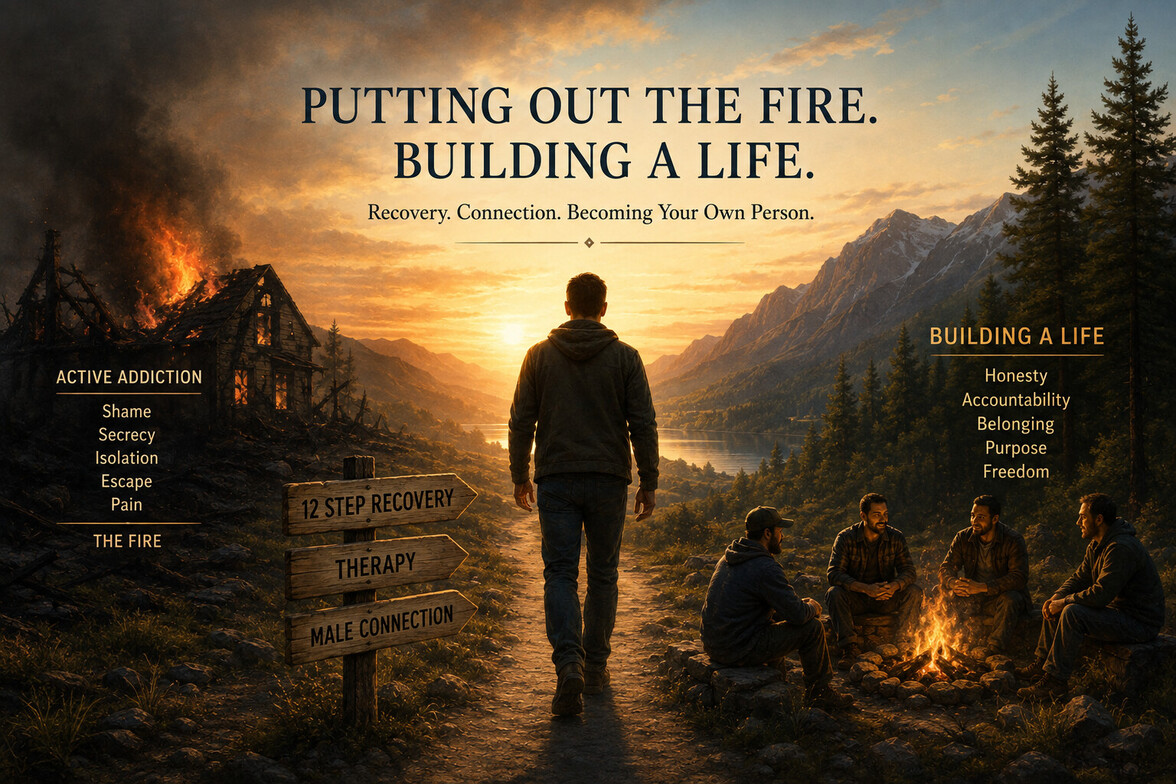
There is an image I often use when thinking about addiction:
If your house is on fire, you are not yet in a position to evaluate the damage. First you have to put out the fire.
When someone is caught in active addiction, enormous amounts of psychological energy are devoted to the addictive cycle.
There may be anticipation, fantasy, craving, acting out, secrecy, consequences, remorse, promises to stop, and eventually another return to the behaviour.
The cycle itself occupies the psyche.
We can certainly begin exploring childhood wounds and relationship patterns during this period. But meaningful psychological work becomes much more difficult when the person continues to use the addictive behaviour to escape the very feelings we are trying to understand.
This is why active addiction needs to be addressed.
The goal is not simply abstinence for its own sake. Removing the addictive behaviour creates the psychological space necessary to discover what lies underneath it.
What Happens When the Coping Mechanism Is Removed?
Stopping an addiction does not immediately make someone feel better.
Sometimes the opposite happens.
The addictive behaviour may have been regulating loneliness, anger, shame, anxiety, grief, emptiness, resentment, fear, or a sense of inadequacy for many years.
When the behaviour is removed, those feelings do not automatically disappear.
They become more visible.
This can be one of the most confusing periods of recovery.
A person may think:
I stopped. Why don't I feel better?
But this is often precisely when the deeper work becomes possible.
The addiction may have functioned as an anesthetic. Once the anesthetic is removed, we begin to feel the wound.
That is not a failure of recovery.
It is the beginning of it.
Recovery Requires Structure
Understanding why we became addicted is important.
Understanding alone, however, is rarely enough.
Recovery needs structure.
For many people, a 12-Step fellowship can provide that structure through regular meetings, connection with others in recovery, sponsorship, accountability, service, spiritual practice, and the daily discipline of living differently.
One of the great strengths of the 12-Step model is its recognition that recovery is not something we accomplish once.
It is something we practice.
Life continues to happen.
Relationships become difficult. People disappoint us. We experience rejection, loneliness, success, failure, stress, boredom, grief, anger, attraction, fear and uncertainty.
These are not interruptions to recovery.
They are recovery.
The question gradually changes from How do I make these feelings disappear? to:
How do I remain present to my life without escaping from it?
A recovery program gives us somewhere to stand while learning how to do that.
The Missing Relationship With Men
But there can be another dimension to the recovery process.
If a boy grew up emotionally enmeshed with his mother while his father was absent, unavailable, passive, addicted, angry, or otherwise psychologically inaccessible, he may have missed an important developmental experience:
learning how to be connected to other males.
A boy needs opportunities to experience himself in relationship with healthy men—not because there is one correct way to be masculine, but because relationships with men can provide forms of identification, belonging, challenge, recognition, and companionship that are developmentally significant.
Without those experiences, some men grow up feeling strangely disconnected from other men.
They may compete with them.
Fear them.
Idealize them.
Reject them.
Seek their approval.
Or simply never learn how to become emotionally close to them.
They may have many male acquaintances while having very few male relationships in which they can speak honestly about fear, shame, loneliness, failure, sexuality, relationships, or vulnerability.
Recovery offers an opportunity to change this.
From Isolation to Brotherhood
Addiction thrives in secrecy and isolation.
Recovery moves in the opposite direction.
It asks us to become known.
This is one reason groups can be so powerful for men.
Whether through a 12-Step fellowship, men's group, group psychotherapy, recovery community, or another healthy community of men, something important happens when a man discovers that he can tell the truth about himself and remain accepted by other men.
He begins to discover:
I don't have to perform here.
I don't have to compete here.
I don't have to pretend I have everything figured out.
I can struggle and still belong.
For someone who has spent much of his life protecting a private inner world, this can be transformative.
The secret room created by addiction gradually becomes less necessary because the person is developing genuine psychological space within himself and genuine connection with others.
The Importance of the Therapeutic Relationship
Therapy can provide another important relationship in this process.
For men dealing with addiction, enmeshment, father wounds, and difficulties with male relationships, it can be particularly helpful to work with a therapist who understands how these issues intersect.
The therapeutic relationship is not simply a place to talk about relationships.
It is itself a relationship.
Patterns inevitably emerge within it.
Difficulty trusting.
Fear of judgment.
The need for approval.
Resistance to depending on another person.
Competition.
Withdrawal.
The desire to appear strong.
Difficulty acknowledging vulnerability.
These patterns can gradually be recognized and worked through within a relationship that has clear boundaries.
The man begins to experience something different: connection without enmeshment.
He can depend on another person without surrendering himself.
He can disagree without destroying the relationship.
He can reveal something shameful without being rejected.
He can be challenged without being humiliated.
And he can eventually carry those capacities into relationships outside therapy.
Recovery and Differentiation
This brings us back to the deeper developmental task.
Recovery from addiction and differentiation from an enmeshed family system are not necessarily separate journeys.
They can be different dimensions of the same journey.
The addiction may have been an unconscious attempt to create separation.
Recovery makes conscious separation possible.
Instead of creating a secret life, the man develops boundaries.
Instead of escaping into fantasy, substances, sex, work, food, gambling, or another compulsive behaviour, he learns to tolerate his internal experience.
Instead of being responsible for everyone else's feelings, he begins taking responsibility for his own.
Instead of either submitting to others or running away from them, he learns how to remain connected while remaining himself.
That is differentiation.
From Surviving to Living
Putting out the fire is only the beginning.
Once the addictive behaviour has stabilized, we can begin walking through the house.
What happened here?
What was damaged?
What was missing?
What needs to be rebuilt?
What belongs to my parents?
What belongs to me?
And perhaps most importantly:
What kind of life do I want to build now?
Recovery provides the foundation.
Therapy helps us understand and repair the deeper patterns.
Healthy relationships with other men provide connection, identification, accountability, and belonging.
Over time, something begins to change.
The goal is no longer simply not to act out.
The goal becomes learning how to live.
To tolerate disappointment without escaping.
To experience loneliness without disappearing into fantasy.
To establish boundaries without drowning in guilt.
To become close to another person without losing yourself.
To allow yourself to need others without becoming dependent upon their approval.
And to become increasingly capable of living as your own person.
Perhaps that is one of the deepest meanings of recovery:
We stop constructing secret places in which to escape our lives and begin building a life we no longer need to escape from.

James Leitch
Contact Me