One of the most common things I hear from clients is, "I wish I had figured this out years ago."
Sometimes it's a career they never pursued. Sometimes it's a relationship pattern they have repeated for decades. Sometimes it's anxiety, addiction, shame, or a deep feeling that life has somehow passed them by. Beneath these struggles is often a quiet grief—the belief that they have missed their chance.
I understand that feeling.
When I was in high school, I wasn't much of a student. I was enrolled in a four-year program, and literature was not part of my world. Then I quit using marijuana and experienced what I can only describe as a spiritual awakening. Suddenly I became fascinated by literature, philosophy, religion, and the deeper questions of life. I decided to enroll in Grade 13, despite being discouraged from doing so by my English teacher, who barely passed me.
Life had other plans.
I eventually completed a master's degree in Literature and Philosophy and, years later, a master's degree in Counselling Psychology. Looking back, I realize that my education didn't begin when someone believed in me. It began when I became ready to learn.
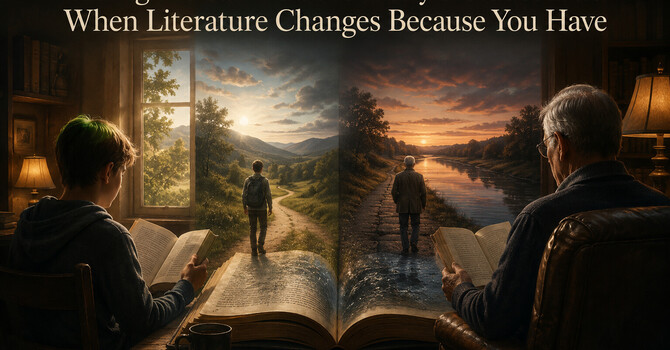
Recently, I have been reading many of the classic novels that students typically encounter in high school—Lord of the Flies, The Old Man and the Sea, The Sun Also Rises, and others. On one level, I am simply reading the books I missed. On another, I am discovering that I couldn't have appreciated them back then in the way I do today.
Experience has become my teacher.
The same principle applies in therapy.
Many people believe healing is about going back and becoming the person they should have been. In my experience, therapy is something quite different. It is about becoming the person you are capable of becoming now. Our past certainly shapes us, but it does not have the final word.
Some lessons cannot be learned at eighteen. They require heartbreak, disappointment, failure, recovery, parenthood, loss, or simply the passage of time. Wisdom often arrives long after intelligence. Emotional maturity develops through experience, not just information.
This is why I believe therapy is less about fixing what is broken and more about creating the conditions in which growth can finally occur. When we begin to understand ourselves with curiosity instead of judgment, something remarkable happens. The very experiences we once regretted become the raw material for transformation.
Many of us carry labels that were given to us years ago: not smart enough, not confident enough, not leadership material, not lovable enough. We continue to live as though those early conclusions are permanent truths. Therapy gently invites us to question those stories and discover that they are often incomplete.
As Carl Jung observed, "The privilege of a lifetime is to become who you truly are." That journey is not reserved for the young. In many ways, it becomes possible only after we have lived enough life to ask deeper questions.
Perhaps that is why I enjoy reading these novels so much today. They are no longer assignments to complete. They are conversations about what it means to be human. They remind me that growth has no expiration date and that there is no deadline for becoming more fully ourselves.
Whether you are twenty-five or sixty-five, beginning a new career, recovering from addiction, grieving a relationship, or simply feeling stuck, it is worth remembering this:
You have not missed your life.
You may simply be arriving at the chapter you were finally ready to read.

James Leitch
Contact Me