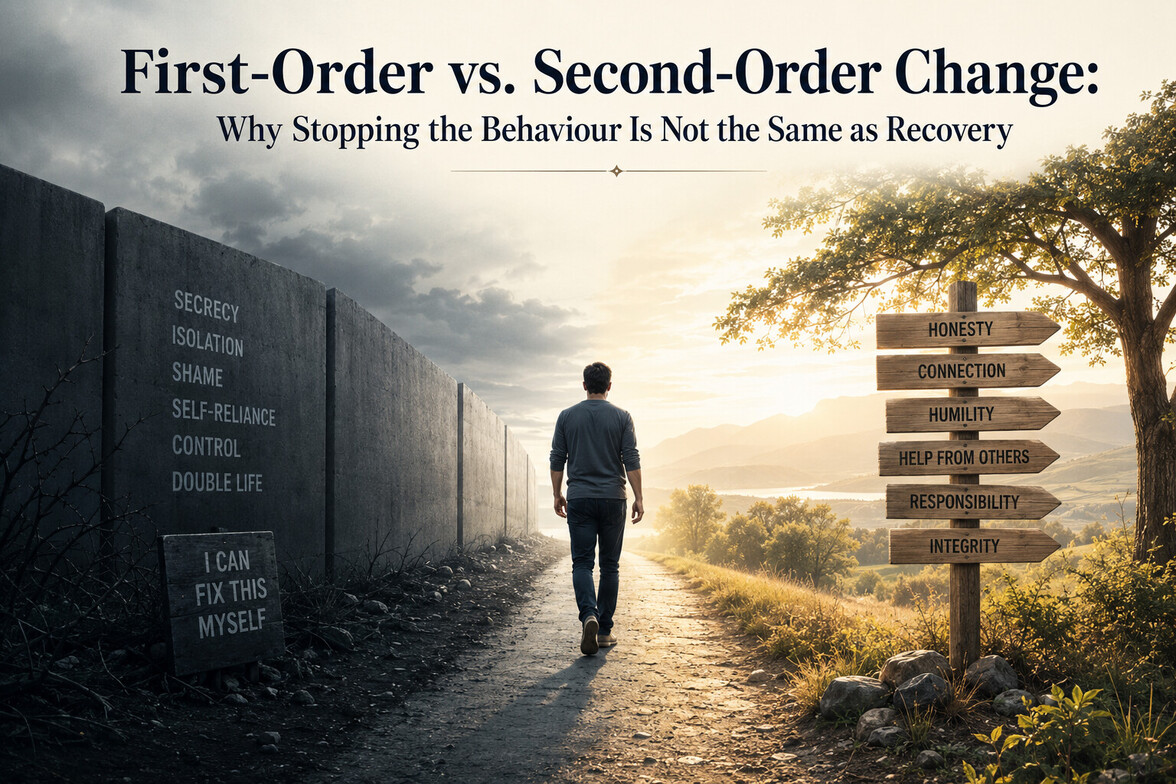
One of the most important ideas Patrick Carnes explores in Facing the Shadow is the difference between first-order change and second-order change.
At first glance, the distinction seems simple. First-order change involves changing what we do. Second-order change involves changing the deeper way we live.
For people struggling with pornography, compulsive sexual behaviour, or other addictions, this distinction can be profound.
A person can stop acting out without fundamentally changing the psychological system that supported the addiction.
They may delete pornography, install accountability software, stop visiting certain websites, make promises to their partner, or maintain abstinence for weeks or months.
Those changes matter. In fact, they are often necessary.
But they are not necessarily the same thing as recovery.
Recovery requires something deeper: a gradual movement from secrecy toward honesty, isolation toward connection, control toward acceptance of limitation, and a divided life toward greater integrity.
That is second-order change.
What Is First-Order Change?
First-order change occurs when we try to solve a problem while essentially remaining within the same underlying system.
Something changes, but the deeper structure remains intact.
In addiction, this often begins with a seemingly reasonable belief:
I can fix this myself.
The person may sincerely want to change. They may feel tremendous remorse after acting out. They may establish new rules, exercise greater discipline, or tell themselves that this time will be different.
Yet underneath these efforts, several assumptions may remain untouched:
-
Nobody really needs to know.
-
I should be able to control this myself.
-
If I try harder, I can figure this out.
-
I don't need other people.
-
What I am doing isn't really hurting anyone.
-
I can keep different parts of my life separate.
This creates a paradox.
The person is attempting to escape the addiction using many of the same psychological strategies that helped sustain it: secrecy, isolation, control and self-reliance.
The behaviour may temporarily stop while the underlying system remains largely unchanged.
The Problem of the Double Life
Addiction frequently involves some degree of compartmentalization.
There is the life other people see and another life that remains hidden.
Someone may be a loving parent, successful professional, dependable friend or committed partner while simultaneously maintaining a secret sexual world.
For a time, this arrangement may appear to work.
And that is precisely what makes it dangerous.
Because the person continues functioning in other areas of life, they may conclude:
I have this under control.
But maintaining separate lives requires increasing amounts of secrecy, compartmentalization and psychological energy.
Eventually, the person isn't simply managing sexual behaviour.
They are managing secrets.
And the need to protect those secrets can gradually influence relationships, emotional availability, sexuality and the person's relationship with themselves.
Second-Order Change Begins With a Different Question
Second-order change begins when the person stops asking:
"How do I make myself stop doing this?"
and begins asking:
"What needs to change in the way I am living?"
That is a radically different question.
The focus shifts from controlling a behaviour to understanding the psychological and relational system surrounding it.
The person begins recognizing some difficult realities:
I cannot necessarily solve this alone.
There are things I cannot control.
My behaviour may have affected other people.
Secrecy has consequences.
Isolation has consequences.
And the addiction may have disconnected me not only from other people, but also from parts of myself.
The goal therefore becomes larger than abstinence.
It becomes integration.
From Secrecy to Honesty
Addiction thrives in secrecy.
Recovery requires bringing reality back into the room.
That does not mean indiscriminately telling everyone everything. Disclosure—particularly within intimate relationships—needs to be thoughtful, clinically appropriate and sensitive to the wellbeing of everyone involved.
But it does mean challenging the internal rule:
"Nobody can know the whole story."
Therapy, recovery groups, sponsors, trusted friends and other forms of appropriate accountability begin breaking the isolation that allowed the addiction to flourish.
The recovering person gradually discovers that being known does not necessarily lead to rejection.
Sometimes it leads to something they may have been seeking through the addiction all along:
connection.
From Isolation to Connection
Many people struggling with compulsive sexual behaviour have learned to regulate themselves privately.
Loneliness, anxiety, shame, rejection, anger, boredom, inadequacy or sexual frustration arise—and rather than bringing those experiences into relationship, the person disappears into fantasy, pornography, masturbation or another compulsive behaviour.
The addiction becomes a private emotional regulation system.
This is why recovery cannot simply be about taking something away.
Something new has to develop in its place.
The person gradually learns:
I can experience distress and remain connected to other people.
I can tell someone I am struggling.
I can experience shame without disappearing.
I can feel lonely without immediately escaping into fantasy.
I can have needs without being ashamed of having them.
I can allow another person to know what is actually happening inside me.
These are much deeper developmental achievements than simply resisting an urge.
From Control to Humility
Another important transition in recovery is the movement from control toward humility.
Grandiosity in addiction does not necessarily look like arrogance.
It can sound surprisingly responsible:
I should be able to handle this.
I can figure this out.
I won't let it happen again.
I know where the line is.
This time I'll control it.
Underneath these statements may be an exaggerated belief in personal control.
Second-order change involves recognizing limitations.
There will be emotions we cannot immediately change.
There will be consequences we cannot undo.
There will be people whose reactions we cannot control.
There may be relationships that take considerable time to repair.
And there may be moments when our own judgment is not enough.
Humility allows the recovering person to say:
"I cannot control everything, but I can become responsible for how I respond."
That is a very different kind of strength.
From a Double Life to Integrity
Perhaps the deepest transformation in recovery is the movement from a divided life toward an integrated one.
Pornography or compulsive sexual behaviour often serves functions beyond sexuality.
It may regulate anxiety.
It may provide escape.
It may soothe loneliness.
It may temporarily relieve shame.
It may provide excitement when life feels empty.
It may offer validation when someone feels inadequate.
It may create an imaginary experience of intimacy without requiring the vulnerability of actual intimacy.
If these underlying functions aren't understood, simply removing the behaviour can leave a psychological vacuum.
Second-order recovery therefore asks an important question:
What was the addiction doing for me?
Not because the behaviour was healthy, but because behaviours that become compulsive usually serve some function.
The next question becomes:
How can I learn to meet those needs differently?
Perhaps through relationships.
Perhaps through emotional regulation.
Perhaps through healthy sexuality.
Perhaps through creativity.
Perhaps through spirituality.
Perhaps through meaningful work.
Perhaps through genuine intimacy.
The goal is not simply deprivation.
It is developing a life in which the addiction becomes increasingly unnecessary.
Abstinence and Recovery Are Not the Same Thing
This distinction helps explain something frequently encountered in addiction treatment.
A person may be abstinent while still organizing their life around many of the psychological dynamics of addiction.
They may not be acting out, but they remain secretive.
They remain emotionally isolated.
They remain deeply ashamed.
They continue trying to control everything themselves.
They don't ask for help.
They avoid vulnerability.
They remain disconnected from their emotional needs.
From the outside, the behaviour has changed.
Internally, much of the addictive system remains intact.
That is the limitation of first-order change.
Second-order change occurs when the person gradually develops a different relationship with themselves, other people, sexuality, vulnerability, responsibility and reality itself.
Recovery Is Ultimately About Becoming More Whole
Pornography and sexual addiction are sometimes understood primarily as battles between desire and willpower:
Can I make myself stop?
But lasting recovery asks a much larger question:
Can I learn to live differently?
Can I tell the truth when hiding would be easier?
Can I ask for help rather than retreat into isolation?
Can I tolerate uncomfortable emotions without immediately escaping them?
Can I acknowledge the impact of my behaviour without collapsing into shame?
Can I accept that there are things I cannot control?
Can I allow myself to need other people?
Can I develop a sexuality based increasingly on intimacy rather than escape?
Can my inner life and outer life gradually become the same life?
These questions move recovery beyond behavioural control and toward something much more fundamental.
The goal is not perfection.
Nor is recovery simply the elimination of an unwanted behaviour.
It is the slow dismantling of a way of living organized around secrecy, isolation and control, and the development of a life increasingly organized around honesty, connection, humility, responsibility and integrity.
In that sense, recovery is not simply about becoming better at controlling ourselves.
It is about becoming more whole.
This article is informed by Patrick Carnes' discussion of first-order and second-order change in Facing the Shadow: Starting Sexual and Relationship Recovery.

James Leitch
Contact Me